Assistant



 Guaranteed provenanceDirect from the estates
 DeliveryFree Home delivery for orders exceeding €300
- Secure PaymentVisa, American Express, Mastercard...
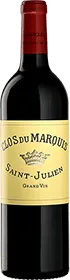
Clos du Marquis 2005
In-Stock
Let's talk about this product!
A pairing in mind? A question about the vintage? Comparison with another product? Find the answers here...
Description
Tasting characteristics and advice for Clos du Marquis 2005
Tasting
Color
The color shows a deep purple hue, almost black.
Nose
The bouquet reveals fine aromatic complexity dominated by ripe dark fruits such as blackcurrant, black cherry and blueberry. Mineral notes of graphite and pencil shavings intertwine with touches of black licorice, delicate vanilla and sweet spices. With aeration, hints of aged leather and tobacco add an extra dimension.
Palate
The attack is round and generous, gradually revealing an impressive yet perfectly sculpted tannic structure. The texture, both silky and slightly chewy, offers lovely fruit density with flavors of blackcurrant, black cherries and stewed blueberries. Secondary notes of sweet tobacco and a subtle earthy impression enrich the palate. Well-integrated acidity carries the wine through to a remarkably long, persistent finish.
Food and wine pairings
This wine pairs ideally with grilled red meats such as a rib steak or thick-cut fillets. It also beautifully complements roasted game such as wild boar with pepper sauce, venison or roasted pigeon. Duck breast with its natural juices is a classic match, as are long-braised meats. A gratin dauphinois or characterful aged cheeses such as Comté round out this wine harmoniously.
Serving and cellaring
Clos du Marquis 2005 is best enjoyed at a temperature between 15.5 and 17°C. Decanting for three to five hours before serving allows the aromas to fully unfold. This wine can be enjoyed until around 2030, with an optimal drinking window extending to 2027-2028 for bottles stored in ideal conditions.
An exceptional Saint-Julien from a historic Bordeaux terroir
The estate
Created in 1902 by the ancestors of the Delon family, the Clos du Marquis is a cuvée in its own right, sourced from distinct parcels located to the west of château Léoville Las Cases. Owned by Domaines Delon, it is now led by Jean-Hubert Delon and his sister Geneviève d'Alton. Clos du Marquis is not the second wine of Léoville Las Cases, but rather the expression of a specific terroir. It holds the unique distinction of being the only vineyard in France bearing the name “Clos” without having walls or fences delimiting its parcels, a status granted in 1902 and now legally impossible to replicate.
The vineyard
The Clos du Marquis vineyard covers around 45 hectares in the Saint-Julien appellation, located approximately 500 meters west of the historic enclosure of Léoville Las Cases. The vines, averaging 30 to 35 years of age, grow on fine Quaternary gravel with sandy-clay elements and a remarkable presence of organic matter at the surface, a legacy of an old forest cover. This distinctive terroir, at an altitude of around 20 meters, benefits from a plateau topography that promotes optimal natural drainage. Harvesting is carried out entirely by hand, with meticulous grape selection.
The vintage
The 2005 vintage is a legendary year for Bordeaux. After a cold, dry winter, early budbreak of cabernet sauvignon in early April was followed by favorable flowering at the end of May. Summer was marked by progressively increasing water stress, with a particularly dry, sunny August without excessive heat. These conditions allowed for harmonious ripening, with the development of thick skins and compact berries containing perfectly ripe seeds, ensuring optimal concentration and exceptional grape quality.
Winemaking and aging
Clos du Marquis 2005 was made at the château Léoville Las Cases facilities, with parcel-by-parcel vinification in temperature-controlled vats of concrete, stainless steel and wood. Lots from Clos du Marquis parcels are kept separate and vinified independently to preserve the integrity of the terroir. Aging takes place over 20 months in French oak barrels, with a moderate proportion of 20% new barrels, allowing the wine to develop aromatic complexity while preserving the pure expression of fruit and terroir.
Grape varieties
Cabernet sauvignon (50 %)
Merlot (37 %)
Cabernet franc (12 %)
Petit verdot (1 %)