Assistant



 Guaranteed provenanceDirect from the estates
 DeliveryFree Home delivery for orders exceeding €300
 Secure PaymentVisa, American Express, Mastercard...
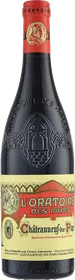
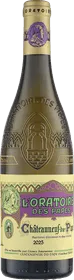
L'Oratoire des Papes : Châteauneuf-du-Pape 2013
In-Stock
Let's talk about this product!
A pairing in mind? A question about the vintage? Comparison with another product? Find the answers here...
Description
Characteristics and tasting tips for the Châteauneuf-du-Pape 2013 Blanc de L'Oratoire des Papes
Tasting
Appearance
The wine displays a deep golden hue with subtle green-gold highlights, reflecting beautiful fruit preservation and lingering youthfulness.
Nose
The nose opens with pronounced notes of acacia blossom accompanied by mineral impressions evoking flint and slate.
Palate
The attack is round and generous, revealing a medium to full body despite the cool conditions of the vintage. The texture balances richness with crisp acidity, creating a sensation that is both broad and structured. The mineral character perceived on the nose translates into a delicate salinity that brings tension and definition. Flavors of fresh pear and melon mingle with spicy notes of ginger and white peach. The finish stretches out at length, leaving lingering mineral and saline impressions accompanied by a subtle, delicate bitterness.
Food and wine pairing
This Châteauneuf-du-Pape Blanc 2013 pairs ideally with John Dory served with Jerusalem artichoke purée or rabbit prepared Provençal-style with olive oil, black pepper and regional herbs. Its minerality and freshness also make it an excellent partner for grilled seafood, simply prepared sea scallops, or white meats in a cream and mushroom sauce.
Serving and storage
It is recommended to serve this Châteauneuf-du-Pape Blanc 2013 at a temperature of around 12°C. Although approachable now, this wine will gain in complexity with a few additional years of cellaring and can be kept until around 2023, or even beyond for lovers of mature white wines.
A mineral and balanced white Châteauneuf-du-Pape
The estate
L'Oratoire des Papes traces its origins to 1880, when Edouard Amouroux inherited through marriage a parcel of vines sheltering a small oratory dedicated to Saint Mark. In 1926, Léonce Amouroux officially registered the brand and created the iconic Art Deco label that endures to this day. Acquired by Ogier in 1999–2000, the estate now belongs to the AdVini group. Under the technical direction of Édouard Guérin since 2015, the property spans approximately 40 hectares, of which 22 hectares are in the Châteauneuf-du-Pape appellation. Committed to organic farming since 2008, L'Oratoire des Papes stands out for its environmentally respectful approach and its elegant expression of the four characteristic soil types of the appellation.
The vineyard
The Châteauneuf-du-Pape vines from which this white wine originates grow primarily on soils of limestone fragments, pieces of Urgonian limestone dating back 115 million years. These arid, shallow terroirs, representing approximately 20% of the appellation and located on its western side, impart exceptional freshness, remarkable minerality and a distinctive salinity to the white wines. L'Oratoire des Papes cultivates 1.5 hectares dedicated to white grape varieties, spread across plots throughout the appellation's terroirs. The estate has practiced horse-drawn plowing since 2006 and has not used any organic fertilizer since 2018, relying exclusively on natural compost made from sheep, horse and cow manure.
The vintage
The 2013 vintage proved particularly challenging in the southern Rhône Valley. Spring was the coldest in several years, with average temperatures one degree below normal and lows dropping to minus 4.4°C. Exceptional rainfall between April and June, totaling 217 millimeters, combined with the cold, caused significant coulure in the Grenache. Summer brought a welcome improvement, notably thanks to a saving storm at the end of July. Harvesting began in the second half of September and continued into October, even early November, making it one of the latest harvests in several decades. Despite historically low yields of 26 hectoliters per hectare, the quality of the harvested grapes proved remarkable, producing white wines with beautiful aromatic freshness dominated by citrus, white flowers and exotic fruits.
Winemaking and aging
The hand-harvested grapes for the Châteauneuf-du-Pape Blanc 2013 are picked in the early morning hours to preserve the freshness of the fruit. The grapes are transported in small crates and then undergo a rigorous double sorting. After gentle pressing, vinification is carried out on a plot-by-plot basis. Aging of approximately six months takes place partly in tulip-shaped concrete tanks, whose ovoid form naturally keeps the fine lees in suspension, and partly in used 300-liter French oak barrels to preserve the delicate mineral character of the limestone terroir. The wine is kept on its lees with regular stirring to develop aromatic complexity.
Grape varieties
Grenache Blanc, Roussanne, Clairette, Bourboulenc