Assistant



 Guaranteed provenanceDirect from the estates
 DeliveryFree Home delivery for orders exceeding €300
 Secure PaymentVisa, American Express, Mastercard...
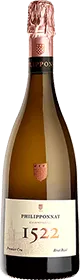
Philipponnat : Cuvée 1522 Grand cru "Long Vieillissement" 2005
In-Stock
Let's talk about this product!
A pairing in mind? A question about the vintage? Comparison with another product? Find the answers here...
Description
Tasting characteristics and tips for Philipponnat’s Cuvée 1522 Grand Cru “Long Vieillissement” 2005
Tasting
Appearance
The wine displays an intense, brilliant golden hue, typical of a champagne that has benefited from twenty years of ageing on lees. The effervescence shows fine, persistent bubbles, forming steady streams that reflect the perfect integration of carbonation over time.
Nose
The bouquet reveals remarkable complexity, with aromas of brioche, gingerbread and dried fruits, alongside subtle notes of mocha. The distinctive minerality of the Aÿ terroir comes through in chalky nuances, while spicy touches reminiscent of white pepper add an extra dimension. With aeration, the nose evolves toward notes of toasted almonds and candied fruits, bearing witness to its long cellar ageing.
Palate
On the palate, this champagne unveils a broad, generous structure while retaining striking freshness thanks to well-preserved acidity. The palate expresses flavors of blackcurrant, chalky minerality and spices, supported by a delicate effervescence. The creamy texture resulting from extended ageing on lees envelops the palate, while the extra-brut dosage of 4 to 4.25 grams per liter allows the wine’s natural character to fully express itself. The finish lingers with persistence, revealing complex aromas and a minerality that brings definition and elegance to the whole.
Food and wine pairings
This champagne pairs ideally with poached or grilled fish, seafood and shellfish that highlight its minerality. It also accompanies poultry with distinction, notably capon, where its dry structure and generous body create a harmonious contrast with the richness of the meat. For those who enjoy bold pairings, this Cuvée 1522 Grand Cru “Long Vieillissement” 2005 can match tandoori-style spicy dishes, where its acidity and minerality provide a refreshing balance. Caviar also makes an exceptional pairing, as the finesse of the effervescence and the purity of the champagne enhance the delicacy of this luxury dish.
Serving and cellaring
Cuvée 1522 Grand Cru “Long Vieillissement” 2005 is ideally served between 8 and 9°C as an aperitif, and between 10 and 12°C when enjoyed with a meal, allowing its complex aromatic palette to fully express itself. This champagne can be enjoyed now and will continue to evolve until around 2035, thanks to its structure and acidity, which give it outstanding ageing potential. It is recommended to store it in a cool, dark place at a stable temperature, laid down horizontally to preserve cork moisture.
An exceptional vintage champagne celebrating five centuries of Philipponnat heritage
The estate
The House of Philipponnat represents one of the oldest continuous family presences in Champagne, dating back to 1522 when Apvril le Philipponnat acquired vineyards in the villages of Aÿ and Mareuil-sur-Aÿ. The House was officially founded in 1910 by Auguste and Pierre Philipponnat. Now led by Charles Philipponnat, who embodies the family’s fifteenth generation, and his son François, who represents the sixteenth generation as export director, the estate remains faithful to its philosophy of excellence and expression of terroir. Since 2010, it has been part of the Lanson-BCC group while retaining its operational independence. Philipponnat stands out for its early commitment to sustainable viticultural practices, having abandoned chemical insecticides thirty-five years ago and chemical weed control twenty years ago. The House owns around twenty hectares of vineyards, including the prestigious Clos des Goisses and the historic Le Léon vineyard in Aÿ, the cradle of the family’s presence since 1522.
The vineyard
Cuvée 1522 Grand Cru “Long Vieillissement” 2005 comes exclusively from Grand Cru- and Premier Cru-classified parcels located in the Vallée de la Marne and the Côte des Blancs in Champagne. The pinot noir comes from the historic Le Léon vineyard in Aÿ, a Grand Cru terroir where the Philipponnat family has grown vines since 1522. This vineyard benefits from a south and southeast exposure on chalky, limestone soils that give the wine its distinctive minerality and exceptional ageing capacity. The chardonnay comes from the Grand Cru villages of Oger and Le Mesnil-sur-Oger in the Côte des Blancs, selected for their freshness and mineral elegance. The vines are farmed according to sustainable viticulture principles, favoring mechanical and manual soil work, with late harvests that allow the grapes to reach optimal ripeness.
The vintage
The 2005 vintage in Champagne began with a mild, dry winter followed by a favorable spring that enabled successful budburst and flowering. Early summer brought favorable conditions through July, when rain and humidity created health challenges requiring careful canopy management. August saw moderately dry conditions with a warm spell that restarted ripening, while September provided the warm, stable conditions needed to bring the grapes to phenolic ripeness, complemented by cool nights that preserved acidity and aromatic complexity. The harvest took place in September under excellent conditions, producing good volumes of chardonnay and pinot noir of superb quality. The 2005 vintage is recognized as an excellent year in Champagne, particularly for leading estates, producing wines defined by remarkable balance and exceptional ageing potential.
Vinification and ageing
Cuvée 1522 Grand Cru “Long Vieillissement” 2005 was vinified using the traditional methods of the Philipponnat House, with a significant proportion of the wine fermented in oak barrels, representing around 26 to 30% of the blend. Malolactic fermentation was deliberately avoided for the majority of the cuvée in order to preserve freshness and the wine’s natural acidity, thereby enhancing its ageing potential. After blending, the champagne was aged on lees for eight years before a first disgorgement. The “Long Vieillissement” designation means that this bottle was kept in the House’s cellars for an extended period before its recent disgorgement, allowing the wine to develop exceptional aromatic complexity under the protection of the yeasts. Only the cuvée—i.e., the first-press juice—was used for this cuvée, ensuring purity and finesse. The final dosage of 4 to 4.25 grams per liter was prepared from fresh reserve wines and pure sugar.
Grape varieties
Pinot noir and chardonnay.