Assistant



 Guaranteed provenanceDirect from the estates
 DeliveryFree Home delivery for orders exceeding €300
 Secure PaymentVisa, American Express, Mastercard...
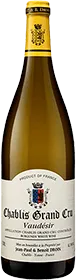
Jean-Paul & Benoît Droin : Chablis Grand cru "Hommage à Louis" 2021
Only 1 available
In-Stock
Let's talk about this product!
A pairing in mind? A question about the vintage? Comparison with another product? Find the answers here...
Description
Tasting characteristics and advice for the Chablis Grand Cru "Hommage à Louis" 2021 by Jean-Paul & Benoît Droin
Tasting
Appearance
The wine displays a pale yellow hue with golden highlights.
Nose
The nose reveals remarkable aromatic complexity. Candied citrus fruit, notably lemon and grapefruit, intertwines with notes of green apple and white peach. A mineral expression dominates, with aromas of flinty gunflint, crushed limestone, and chalk. Toasted nuances of hazelnut and subtle smoky touches complete this bouquet, reflecting aging on lees in barrel.
Palate
The attack is both generous and taut. The palate unfolds flavors of white citrus, especially lemon zest and grapefruit, alongside apple and white stone fruits. The structure impresses with its pronounced salinity, evoking the terroir’s marine origins. The finish lingers beautifully with chalky minerality, oyster-shell notes, and a touch of delicate spice. The balance between power and finesse defines this outstanding grand cru.
Food and wine pairings
This Chablis Grand Cru pairs magnificently with fine fish such as monkfish, turbot, or line-caught sea bass. Shellfish and seafood also make remarkable matches, notably oysters, langoustines, scallops, and lobster. Japanese preparations such as sushi and sashimi offer compelling harmonies thanks to the wine’s minerality. Simply prepared roasted poultry can also work well.
Serving and cellaring
The Chablis Grand Cru "Hommage à Louis" 2021 is ideally served between 12 and 14°C. Decanting for around thirty minutes to one hour allows the wine to fully express its aromatic complexity, particularly in its youth. This wine can be enjoyed through at least 2035, and potentially beyond under optimal cellaring conditions.
An exceptional Chablis Grand Cru celebrating Burgundy’s family heritage
The estate
The Domaine Jean-Paul & Benoît Droin perpetuates a family winemaking tradition dating back to 1547 in Chablis. Now led by Benoît Droin, representing the fourteenth generation, the estate spans around 26 hectares across Chablis’ four appellation levels, including five Grands Crus. Trained at the Lycée Viticole de Beaune and holding a degree in oenology from the University of Dijon, Benoît Droin joined the family estate in 1999 and assumed full leadership in 2014. The domaine exports 65% of its production to more than fifty countries. The Droin family played a major historic role in Chablis’ institutional development, notably through Louis Droin, co-founder in 1908 of the Union des Vignerons de Chablis contre la Fraude.
The vineyard
The Chablis Grand Cru "Hommage à Louis" comes from a historic 22.36-are parcel located at the junction of the climats Les Clos and Valmur, acquired by Louis Droin in February 1922. This outstanding terroir benefits from an optimal south and southwest exposure. Its geological complexity is characterized by Kimmeridgian soils composed of limestone on the surface, a layer of blue clay mid-slope, and deeper, more clay-rich soils at the foot of the hillside. The vines, averaging around forty years old, are farmed according to sustainable practices, with regular plowing of the soils. This geological mosaic gives the wine remarkable mineral depth.
The vintage
The 2021 vintage in Chablis began with spring frosts that threatened certain early-budding parcels. Despite these delicate initial conditions, the growing season then unfolded favorably, allowing the grapes to reach balanced ripeness while preserving acidity. The climatic conditions ultimately produced wines with characteristic tension and pronounced mineral intensity, promising excellent aging potential.
Winemaking and aging
After hand-harvesting, the grapes for the Chablis Grand Cru "Hommage à Louis" 2021 are gently pneumatically pressed. The must undergoes enzymatic settling at 15°C for twelve to twenty-four hours. Alcoholic fermentation is carried out with indigenous yeasts, simultaneously in temperature-controlled stainless-steel tanks and in oak barrels. This mixed approach preserves mineral freshness while adding complexity and structure. Full malolactic fermentation takes place over eight to ten months, followed by extended aging on lees with bâtonnage for the barrel-aged wines. The final blending of this Burgundy wine precedes bottling after light fining and filtration if necessary.
Grape variety
100% Chardonnay.