

 Guaranteed provenanceDirect from the estates
 DeliveryFree for purchases over 3,315 SEK
- Secure PaymentVisa, American Express, Mastercard...
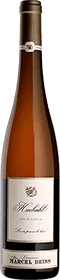
Domaine Marcel Deiss : Huebuhl 2017
Only 1 available
In-Stock
Description
Characteristics and tasting advice for the Huebuhl 2017 from Domaine Marcel Deiss
Tasting
Color
The wine displays a golden hue with amber highlights, reflecting the influence of noble rot on the grapes in this vintage.
Nose
The nose reveals a complex, generous aromatic profile. Botrytised notes lead the way with aromas of candied orange, floral honey, white peach, and dried apricot. In the background, more subtle nuances emerge: citrus zest, white tea leaves, and a saline mineral touch, accompanied by light notes of toasted almond.
Palate
On the palate, the wine impresses with its power and remarkable balance. The attack is rich and generous, with a fine expression of exotic fruits and baked apricots. The texture is round and luscious, carried by vibrant acidity that brings freshness and tension. The terroir’s hallmark minerality comes through fully, giving the wine a distinctive saline dimension. The finish lingers long on caramelized notes of candied apricot and poached pear, lifted by a slight citrus bitterness and a refreshing mineral sensation.
Food and wine pairings
This wine pairs beautifully with refined dishes such as lobster with butter, langoustines served with saffron risotto, or semi-cooked foie gras with gingerbread. It also elevates fruit-based desserts such as apricot tarts or lemon meringue pies, as well as traditional Alsatian pastries. Its complexity also allows it to be enjoyed on its own, as a wine for contemplation.
Serving and cellaring
The Huebuhl 2017 can be enjoyed now to appreciate its current aromatic richness, but it also has aging potential that will allow it to evolve favorably over the coming years.
A Premier Cru from Alsace expressing the unique philosophy of Domaine Marcel Deiss
The estate
Founded in 1947 by Marcel Deiss upon his return from the Second World War, the Domaine Marcel Deiss is part of a family winegrowing tradition dating back to 1744 in Bergheim. Since 1973, Jean-Michel Deiss has run this 26 to 27-hectare estate spread across nine Alsatian communes. Now assisted by his son Mathieu, recognized among the fifty best winemakers in France, the estate has established itself as a global benchmark thanks to its revolutionary practice of co-planting and its commitment to Demeter-certified biodynamics since 1998. This philosophy favors the expression of terroir over that of grape variety, placing Domaine Marcel Deiss at the forefront of contemporary Alsatian viticulture.
The vineyard
The Huebuhl vineyard, whose name means “place of early and humid growth” in old Alsatian, lies between Bergheim and Ribeauvillé, at the top of a pass that separates the two villages. Planted in co-planting in keeping with the estate’s philosophy, it brings together three main grape varieties: pinot blanc, pinot gris, and pinot noir. The vines, 15 to 35 years old in the 2017 vintage, are grown at an exceptional density of 8,000 vines per hectare. The terroir is defined by cool clay soils over an ancient lacustrine base, giving the wines a chiseled minerality and naturally high acidity. Its slightly hollow topography, with southern exposure, encourages the development of noble rot when conditions are favorable.
The vintage
The year 2017 ranks among the outstanding vintages in Alsace. After an extremely cold winter and a dry spring, the summer was marked by high temperatures and prolonged drought. These conditions created moderate water stress, favoring berry concentration. The 2017 vintage is among the five earliest harvests of the last forty years, with most of the picking completed before the end of September. The combination of summer heat, dryness, and exceptional phenolic ripeness produced wines of remarkable quality. For Huebuhl, these conditions were particularly favorable to the development of noble rot, bringing aromatic complexity and natural concentration.
Winemaking and aging
The Huebuhl 2017 grapes are harvested by hand at optimal ripeness and then gently pressed in a traditional basket press. The must rests at natural cellar temperature, allowing indigenous yeasts to spontaneously colonize the juice. Alcoholic fermentation takes place without the addition of commercial yeasts, unfolding over several months through a natural process. No chaptalization is carried out. The wine is then aged in large oak foudres for a minimum of one year, with regular stirring of the fine lees to enrich texture and complexity. Before bottling, very gentle filtration preserves the wine’s aromatic integrity.
Grape varieties
Pinot blanc, pinot gris, and pinot noir grown in co-planting.