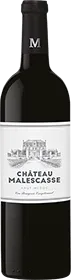


Château Malescasse 2019
In-Stock
Marks and reviews
 Parker
 J. Robinson
 Decanter
 J. Suckling
 Vinous - A. Galloni
 The Wine Independent
 Alexandre Ma
 Vinous Neal Martin
Description
Characteristics and tasting advice for Château Malescasse 2019
Tasting
Color
The color reveals a beautiful deep ruby red with violet highlights.
Nose
Powerful and precise, the nose charms with its great finesse and aromatic complexity. It reveals aromas of blackcurrant, blackberry and wild strawberry, complemented by notes of licorice. As it opens up, hints of mocha, roasted coffee and menthol add an extra dimension to this elegant, fresh bouquet.
Palate
The attack is full and focused. The palate stands out for its silky texture and delicate volume. The tannins, fine and elegant, are perfectly integrated, offering both structure and suppleness. The palate reveals lovely juiciness and pleasant freshness, with notes of graphite and camphor that bring a mineral tension. The finish, long and persistent, brings the fruit back with elegance, carried by refined tannins.
Food and wine pairings
This Château Malescasse 2019 pairs perfectly with red meats such as a beef tournedos with morels, braised beef or an old-fashioned beef stew. It also matches very well with feathered game, roast or grilled lamb, as well as roast poultry. For cheese lovers, opt for aged cheeses such as Comté. More surprisingly, this wine also pairs well with Asian dishes such as Vietnamese phở or mushroom-based preparations.
Serving and cellaring
Château Malescasse 2019 benefits from being decanted for around 90 minutes before serving when young. It is recommended to serve it at a temperature of 15.5°C to preserve its freshness and elegance. This wine can be enjoyed now but will continue to evolve until around 2038.
An elegant and complex Haut-Médoc born of Médoc gravel soils
The estate
Founded in 1824 in Lamarque, between Margaux and Saint-Julien, Château Malescasse is a Cru Bourgeois Exceptionnel from Haut-Médoc, at the heart of Bordeaux’s great gravel soils. Owned by Philippe Austruy (Vignobles Austruy) since 2012, the estate has benefited from a complete restructuring: a fully renovated cellar, a thoroughly reorganized vineyard, and a restored chartreuse. Its long-sought-after Médoc gravel terroir shapes a style defined by elegance.
The vineyard
The Château Malescasse vineyard spans forty hectares in a single block in the commune of Lamarque, in the Haut-Médoc appellation. Located at the highest point of the Médoc at thirty meters above sea level, it enjoys a prime geographical position close to the Gironde estuary. The terroir is made up of Quaternary gravels of Pyrenean origin, mixed with clay, limestone and sand, providing excellent drainage. The vines, averaging thirty-five years of age, are managed with parcel-by-parcel attention, favoring environmentally respectful viticultural practices. The estate has been certified Haute Valeur Environnementale level 3 since the 2019 vintage.
The vintage
The winter of 2018-2019 was dry and mild, leading to early budbreak. Spring alternated mild and cool periods with rainfall, creating delicate conditions for flowering, which nevertheless went well despite wind, cool temperatures and rain. The summer of 2019 was exceptionally hot, with temperatures regularly exceeding seasonal averages and reaching 40°C on July 23 and 24. Fortunately, summer rainfall prevented water stress despite the heat. September offered ideal conditions—warm, dry and sunny—allowing for a harmonious harvest spread out over time.
Vinification and aging
The Château Malescasse 2019 harvest was carried out by hand, with rigorous sorting on a vibrating table and by density sorting. After vertical destemming without crushing, parcel-by-parcel vinification took place in small wooden and concrete vats from 60 to 110 hectoliters. Maceration, lasting three to four weeks, favored gentle extractions through moderate punch-downs and short pump-overs. Malolactic fermentation took place in French oak barrels. The aging of Château Malescasse 2019 continued for twelve months in barrels, divided into one-third new oak, one-third once-filled barrels and one-third twice-filled barrels.
Grape varieties
Cabernet Sauvignon (49%)
Merlot (45.5%)
Petit Verdot (5.5%)