Assistant


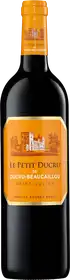
Le Petit Ducru de Ducru-Beaucaillou 2025
En Primeur Wines – delivery in early 2028
Let's talk about this product!
A pairing in mind? A question about the vintage? Comparison with another product? Find the answers here...
Description
Characteristics and tasting notes of Petit Ducru de Ducru-Beaucaillou 2025
Tasting
Nose
The aromatic bouquet reveals seductive scents of ripe black and red fruits, evoking plum and cherry. With aeration, subtle spicy notes delicately enrich the whole.
Palate
From the attack, this wine proves round and wonderfully smooth. The substance unfolds with a homogeneous and supple texture, leading to a harmonious finish, perfectly balanced and imbued with a lovely sense of fluidity.
Food and wine pairings
This cuvée pairs wonderfully with roasted or grilled red meats, such as a fine rib steak or a leg of lamb. It will also enhance characterful poultry such as duck breast, flavoursome bistro-style dishes, or medium-aged cooked pressed-curd cheeses.
Serving and cellaring
To fully appreciate Le Petit Ducru de Ducru-Beaucaillou 2025, serving at around 15.5 to 16°C is recommended. Designed to offer accessible pleasure from its youth, this wine can be enjoyed with delight until around 2035.
The elegance of a Saint-Julien wine crafted by Château Ducru-Beaucaillou
The estate
Acquired by Bertrand Ducru in 1797, Château Ducru-Beaucaillou spans 105 hectares of deep gravel soils scattered with the iconic large pebbles in Saint-Julien-Beychevelle, in the Bordeaux Médoc. The Borie family has owned this estate since 1941, when Francis Borie acquired it. This 2nd Growth of the 1855 Classification is today led by Bruno-Eugène Borie, who upholds the excellence of the property. The Victorian château overlooking the cellars has produced three distinct cuvées since its restructuring.
The vineyard
The grapes used for this cuvée come mainly from the estate's western plots, located in the heart of the Saint-Julien appellation. This terroir lies on Günzian gravel soils, slightly less deep than those bordering the estuary. The vines, planted at a high density of 10,000 plants per hectare, benefit from environmentally respectful management, the estate applying methods drawn from organic farming to preserve the vitality of its soils and biodiversity.
The vintage
The 2025 vintage stands as the earliest in the estate's history. The vegetative cycle began with an early spring, leading to early budburst, flowering and veraison. Between May and July, the vines endured significant water stress, naturally limiting yields and producing small, highly concentrated berries. Fortunately, providential rainfall at the end of the summer season helped preserve all the freshness of the fruit. The harvest thus took place swiftly, from 2 to 23 September.
Grape varieties
This blend is composed of 83% Merlot, 9% Cabernet Sauvignon and 8% Petit Verdot. Alcohol content: 13.51% vol.