Assistant


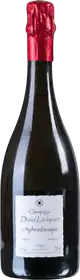
David Léclapart : L'Aphrodisiaque 2018
In-Stock
Let's talk about this product!
A pairing in mind? A question about the vintage? Comparison with another product? Find the answers here...
Description
Characteristics and tasting advice for L'Aphrodisiaque 2018 by David Léclapart
Tasting
Nose
The nose initially reveals beautiful, intense and captivating fruit aromas. With aeration, the bouquet evolves toward notes of fine pastry and dried fruits, enriching the aromatic palette of this cuvée.
Palate
The attack is straightforward and intense. On the mid-palate, the lovely fruity notes already perceived on the nose reappear. The silky, remarkably elegant texture leads into a delicious finish with notes of candied fruit, always carried by a fine mineral freshness.
Other characteristics
L'Aphrodisiaque 2018 is a zero-dosage Champagne with an alcohol content of 12.5%.
A biodynamic Premier Cru Champagne from Trépail
The estate
This Champagne House was founded in 1996, when David Léclapart took over the family estate in Trépail on the Montagne de Reims, and spans 3 hectares farmed biodynamically. A pioneer of this approach in Champagne since the late 1990s, David Léclapart obtained Demeter certification in 1998. As the spiritual heir to Anselme Selosse, he produces 15,000 bottles each year, mainly from Chardonnay. His cuvées, whose names all begin with “A”, are vinified without additives, with spontaneous fermentation and aging in Burgundy barrels. David Léclapart Champagne embodies an exceptional artisan approach to winegrowing, prized by connoisseurs.
The vineyard
The vineyard of L'Aphrodisiaque 2018 is located in the commune of Trépail, in the Grande Montagne de Reims, in the wine region of Champagne. The parcels rest on a clay-limestone soil from the Upper Campanian. The planting density is 10,000 vines per hectare. Pruning is carried out using the “Chablis” method, with an average yield of one kilogram per vine.
Winemaking and aging
L'Aphrodisiaque 2018 is always vinified as a single-varietal wine. The harvest is carried out by hand, followed by direct pressing on a traditional vertical press with blending of the press fractions. Spontaneous fermentation takes place with the wine’s native yeasts over a period of 3 weeks to 2 months, without enzymes, filtration or fining. Malolactic fermentation also occurs spontaneously. The base wine is aged on its lees for 11 months, 90% of which is in used 225-liter Burgundy barrels. Aging on laths lasts at least 44 months.
Grape varieties
Chardonnay (80%)
Pinot Noir (20%)