Laherte Frères: the village of Chavot, ten crus, a négociant status and parcel-by-parcel vinification
A pivotal village on the southern slopes of Épernay
Laherte Frères is based in Chavot, south of Épernay, in that part of Champagne lying between the Côte des Blancs and the Vallée de la Marne. The subsoil combines chalk and clay, and Aurélien Laherte reads it simply: chalk refines his Pinot Noir compared with that of the Vallée de la Marne, while clay rounds out his Chardonnay compared with that of the Côte des Blancs. Meunier, long regarded as a supporting grape variety, ripens fully here. It is the grape that made the house's reputation.
Seven generations, ten crus
Jean-Baptiste Laherte founded the estate in 1889, in a village then spelled Chavost. Aurélien, the seventh generation, has run it since 2005. The vineyard covers just over 10.5 hectares, divided into more than 75 parcels across ten crus: mainly Chavot, Épernay, Vaudancourt, Moussy, Mancy and Morangis, with Chardonnay in Vertus and Voipreux, and Meunier in Le Breuil and Boursault.
Pressing immediately, vinifying each parcel separately
At Laherte Frères, each village and each microclimate is vinified separately, after passing through one of the two traditional 4,000-kilo presses located in the heart of Chavot. The grapes are pressed as soon as they arrive from the vineyard because, according to the family, it is the presses that wait for the grapes, never the other way round. Indigenous yeasts, oak ageing for most of the wines, and malolactic fermentation decided cuvée by cuvée. In the vineyard, spring ploughing aerates the soil, while autumn ploughing cuts the surface roots to push the vine towards the chalk.
Rosé de Meunier, Les Beaudiers, Grandes Crayères, Bouzy: choosing a Laherte Frères Champagne
The Rosé de Meunier, the entry point to the range
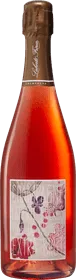
Like every cuvée in the selection, the Rosé de Meunier carries in its name what defines it: it is Laherte Frères' non-vintage blended rosé, 100% Meunier. Three vinification methods are combined: 60% white wine, including a share of reserve wines aged in barrels, 30% grapes that underwent a short maceration, and 10% red wine. The maceration brings substance, the red wine aromatic depth, and the white wine freshness. It is the most approachable cuvée on the page, perfect to serve as an aperitif.
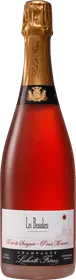
Les Beaudiers, a Chavot lieu-dit as a saignée rosé
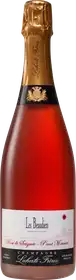
Les Beaudiers is a saignée rosé: the colour comes solely from contact between the juice and the skins, with no addition of red wine. The Meunier comes from very old vines in this lieu-dit of Chavot, vinified in barrels without malolactic fermentation. More vinous than the Rosé de Meunier, it calls for the table. The Oenothèque 2016 version is the same cuvée, aged for a long time by the house before its release: the most direct way to taste a rosé Champagne from Laherte Frères that has already developed a patina of age.
Les Grandes Crayères: Chardonnay and outcropping chalk
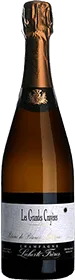
Les Grandes Crayères is the vintage Blanc de Blancs from Chavot. Its Chardonnay vines, more than 35 years old, grow on a west-southwest-facing slope, where Campanian chalk lies beneath only about twenty centimetres of soil. Fermented in barrels three to ten years old, without malolactic fermentation, the wine spends around three years in the cellar before disgorgement and receives a dosage of 3 to 4 g/l. It retains a saline, almost chalky finish, making it one of the most taut Blanc de Blancs in the selection.
Bouzy, Pinot Noir from the Montagne de Reims
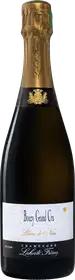
First made with the 2021 vintage, the Bouzy Grand Cru Blanc de Noirs takes Laherte Frères beyond its home slopes. It blends two parcels of Pinot Noir planted in 1986 and 1988, one at the bottom and the other at the top of a south-facing slope, between 150 and 190 metres. Aged in barrels, without malolactic fermentation, it is dosed at only 2 g/l. Where Les Grandes Crayères focuses on tension, this Blanc de Noirs brings the structure of Pinot Noir.
Dosage, malolactic fermentation, ageing: when to open Laherte Frères Champagnes
Dosages kept to a minimum
All the cuvées in the selection are Extra Brut Champagnes. For the Laherte family, a low dosage is the only way not to overshadow the work carried out in the vineyard and the cellar: the sugar added at disgorgement must neither mask the fruit nor erase the minerality.
Without malolactic fermentation, wines that need time
Should a Blanc de Blancs without malolactic fermentation be opened as soon as it arrives? Rarely. By retaining malic acid, which is sharper than lactic acid, these wines keep a firm acidity that slowly melts away in the bottle. The Rosé de Meunier can be enjoyed without waiting; Les Grandes Crayères, Bouzy and Les Beaudiers benefit from a few years in the cellar. The Oenothèque 2016 gives an idea of what this time brings.